So alarming they renamed it: What the Independent Review really found
Tonight, the government finally published its damning independent review into Hillingdon Council’s finances. The report, written in May by the Chartered Institute of Public Finance and Accountancy (CIPFA), is far blunter than anything on the Council’s own news pages – and its findings led directly to the government issuing a formal Best Value Notice (not a good thing!) earlier this month.
Even the independently chaired board set up to provide oversight didn’t survive the process unscathed. CIPFA notes the Council’s “Assurance Board” had already been “retitled an Improvement Board recognising the fundamental need for change” – and, tellingly, that “a number of key interviewees were unaware” it existed at all.
But the naming saga isn’t really the story. Four other findings matter more…
A decade and a half of low council tax
For nearly ten years from 2009, Hillingdon simply didn’t raise council tax at all. The consequence, CIPFA finds, is stark: “Council Tax levels are 14.5% lower than the mean average for outer London.” Bringing the Council up to that median would generate “an additional £26.6 million of Council Tax income” every year – more than enough, on its own, to close a large part of the current budget gap.
Compared to its neighbours, Hillingdon’s Band D tax has fallen from just £6 below the outer London average in 2010 to £234 below it today.
“No political will,” and no plan B
Officers had already drawn up a list of the genuinely difficult choices facing the Council – fortnightly bin collections, reviewing the library network and its three theatres, an above-referendum council tax rise.
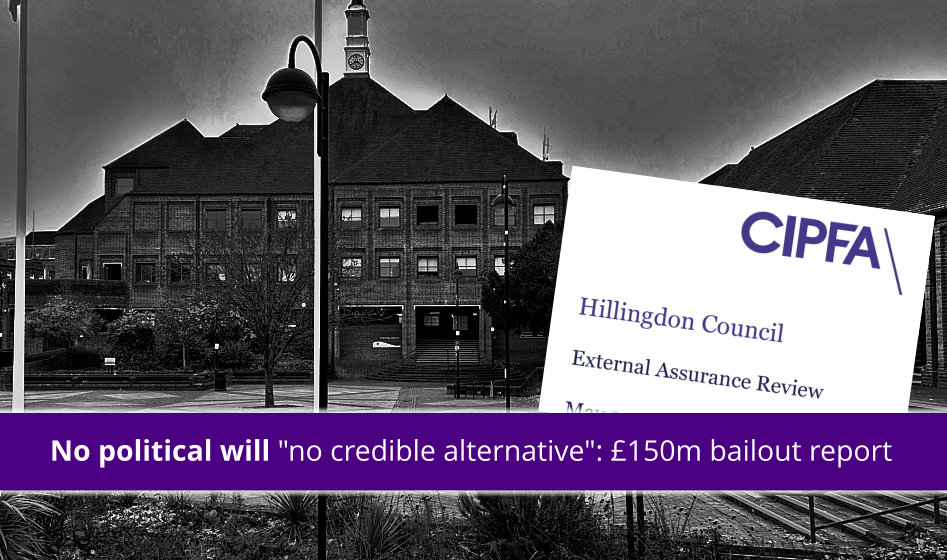
CIPFA’s verdict on what happened to that list: “there appears to be no political will to take these decisions and, perhaps more importantly, if not the measures on the list then no credible alternative.”
Scrutiny “on party-political lines”
Even where the Council does face challenge, CIPFA questions whether it counts for much. Its scrutiny committees, the report finds, “appear to act more on the basis of party-political lines rather than on trying to determine whether policies or decisions reflect good governance or value for money“.
Overall, CIPFA concludes, there is “a lack of depth in the scrutiny arrangements.”
Nearly half its own risks are rated “could embarrass the Council nationally”
Buried in CIPFA’s own methodology is a definition of its highest risk rating. A “Critical” impact, it explains, is one that could require “subsequent intervention by MHCLG or other 3rd parties,” reach “national press interest,” and cause “major political embarrassment for members.”
By CIPFA’s own scoring, eight of the eighteen risks it identified at Hillingdon sit at exactly that level.
What this means
None of this is speculation. It is the government’s own commissioned assessment of a council asking residents to accept a £150 million, 20-year debt. Council tax has fallen behind its neighbours for fifteen years.
Officers drew up a list of hard choices; there is “no political will” to make them. The scrutiny committees argue on party lines rather than asking whether decisions are any good. CIPFA’s own brief asked whether the Council’s strategic direction was real, or existed only “in name only” – its findings answer that without quite saying so out loud: “the strategic direction of the authority is not clear or understood.” That is the pattern: not one failure, but structures that exist on paper and stop working the moment they’re actually needed.
Three of the people best placed to explain this chose silence instead. Residents deserve better than that – and we’ll keep asking until we get it.
EDITORIAL Note: Silence from the Civic Centre
On Monday, the Ruislip Residents’ Association wrote to Chief Executive Tony Zaman, the Council’s Leader Cllr Steve Tuckwell, Cabinet Member for Finance Cllr Eddie Lavery, and the Corporate Communications Team – asking basic questions about the new Improvement Board and the government’s intervention. As of publication on Thursday, neither the Chief Executive, the politicians, nor the Communications Team had answered a single question.